
 “My first question is: are enquiries down, or just visits? If your leads or new business are holding up, falling sessions may simply mean people are getting their answer before they click and turning up later, readier to act.”
 “EEAT is huge in terms of being cited by AI and ranking well in Google. Google has all this information, and with all the AI content now pulling that same information from Google, everyone is starting to tell the same story. What unique information can you offer that Google hasn’t heard before? Which specialist in the subject can you ask the questions no one has answered yet?”
06.07.2026|
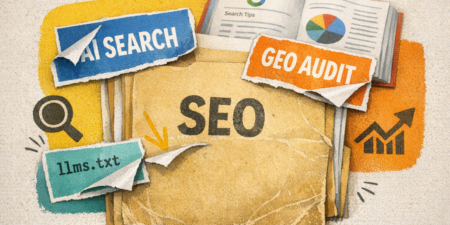
SEO is still SEO. Google recently published its first official guide to optimising for its AI search features, and the headline for anyone being sold a pivot is a short one.
Your organic traffic report no longer shows the full search journey. If your analytics show sessions drifting down over the past year, you’re not imagining it, and you’re not alone.
What matters more is whether the drop is costing you enquiries and sales, because the answer decides what you should do next.
People are getting their answers before they click. SparkToro’s 2026 study, built on Similarweb clickstream data, found that 69.5% of UK Google searches ended without a click in the first four months of the year, the highest rate of the six countries it measured.
B2B research is moving faster still. A survey of 1,076 B2B software buyers found that 51% now start their research with an AI chatbot more often than with Google, up from 29% eleven months earlier. 71% use a chatbot at some point in the process.
That rate of change matters more than the headline number. A behaviour that moved from under a third of buyers to half of them inside a year is still moving, so whatever your analytics showed in January won’t be what they show in December.
The traffic that does arrive by this route is growing fast. Continuing our research, we found that WebFX analysed 2.3 billion sessions and found that traffic from generative AI platforms grew 796% between January 2024 and December 2025. It’s a vendor study, and AI still made up only 0.18% of sessions in 2025, so a big percentage rise is easy to come by from a base that small. The direction is clear enough.
In most cases, the buyer is still there. Their research has just moved somewhere your analytics can’t see as clearly.
When organic traffic dips, the first instinct is often to treat it as a visibility problem and chase more of it. A better starting point is the commercial outcome.
“My first question is: are enquiries down, or just visits? If your leads or new business are holding up, falling sessions may simply mean people are getting their answer before they click and turning up later, readier to act.”
Beth Moore, Head of Client Services, Door4
It’s a quick question to answer, and it separates two very different situations. If enquiries are flat and sessions are down 20%, your conversion rate has gone up, and the site is working harder per visit. If both lines are falling together, you have something to fix.
Megan Jones, SEO Executive here at Door4, regularly sees businesses read less traffic as fewer sales. “Not every user is going to convert,” she says, “it’s about being in front of the ones that are, at the moment they’re looking for what you’re offering.”
Chasing the old traffic number can send time and budget towards visits that rarely led to an enquiry in the first place.

We’ve seen this play out with a client recently. Over the past year, organic sessions to most of their service pages drifted down, some to their lowest point in two years. Conversions from those same areas held steady or grew strongly.
Two patterns stood out in the conversion paths. Most enquiries had an organic visit somewhere in the journey, and a large share took more than one visit, often spread over a couple of weeks. Around two-thirds of organic conversions landed on the homepage, office pages or people pages, away from the service pages where the research started.
Our reading is that people research early, often through an AI answer, then come back by brand name when they’re ready to act. The service page still did its job; it just stopped being the page that recorded the conversion. That’s why a page-level traffic report reads as a decline while the enquiry report holds up.
AI platforms can also shape a visit without getting the credit. Someone might start in ChatGPT, remember your name and come back a week later through Google or by typing in your address. Their final session won’t show as an AI referral, so look at assisted conversions, branded search and lead quality alongside referral sessions.
There’s a harder side to this. A randomised field experiment, reported by Search Engine Journal, found AI Overviews cut outbound organic clicks by 38% on queries where they appeared, with zero-click searches rising from 54% to 72% when an Overview was shown. It’s a working paper that hasn’t been peer-reviewed yet, though it’s the first randomised test of how AI Overviews affect clicks.
On those queries, the Overview is taking the click. The same experiment also shows where it affects us most. Overviews appeared on 53% of informational queries in the study, compared with 6% of transactional ones.
That split is why Megan is wary of chasing visibility for its own sake. “Users looking to make a purchase for ‘blue jeans’ are still more likely to scroll down to the retailers actually selling blue jeans, than read an AI overview about them. It’s about balance, and appearing where there is value, rather than appearing everywhere.”
The mix of queries your site depends on decides how hard this hits you. A site built on top-of-funnel guides will feel it more than one built on product, service and category pages.

Two datasets often get quoted together on this, and they’re worth keeping apart. Adobe’s retail analytics found that during the 2025 holiday season, AI-referred visitors spent 45% more time on site, viewed 13% more pages and converted 31% more often than visitors from other sources. That’s US retail traffic at the busiest point of the year.
WebFX, in the same study that produced the 796% figure, found AI-referred visitors converting at around 1.2 times the rate of organic search. That’s a far more modest uplift, from a different dataset covering a different group of people.
Both point the same way: a visitor who arrives after an AI answer tends to be further down the decision path than one who arrives from a cold search. Fewer visits, further along. Your traffic report gets worse while your per-visit value gets better, and only one of those shows up on the dashboard most boards look at.
A 31% conversion advantage applied to a confusing checkout still produces a poor conversion rate. Someone who has already compared options and narrowed their shortlist needs quick confirmation that you can help. Making them dig through six pages to find a price or a way to get in touch wastes the work that brought them there.
In Megan’s experience, some sites “can confuse users more than help them along. If a user is repeatedly being sent to page after page without any real direction how to make that final decision, they’re going to leave more confused than they started, and you’ll lose them as a potential customer.”
The arithmetic works against you here. If AI referrals are a small share of your sessions and organic volume is falling, the visits you do get have to work harder to hold your enquiry numbers up. A conversion path that lost visitors when volume was healthy loses the same share now, against a smaller base.
In our experience, the common faults are dull ones, and most sites have at least one. A quick check covers:
These faults predate AI search by years, and they decide whether the shift helps or hurts you.

Being picked up by an AI answer runs on the signals that have always mattered for organic search: structured content, authority, technical health and something worth citing.
Megan Jones, SEO Executive, Door4
AirOps’ analysis of AI Overview citations points the same way. Original research, proprietary data and real case studies get picked up more readily than generic, rephrased advice.
For one of Beth’s clients here at Door4, the pages cited in AI answers were the in-depth content: “a series of guides answering one very specific question people research.” Each of those pieces “now picks up thousands of AI Overview impressions”, and more than a hundred pages that had no clicks a year earlier are now bringing traffic in.
The research pages earn the citation and the brand pages earn the conversion. Those are two different jobs that need different pages, which is worth knowing before you decide a guide with few clicks has failed.
Publishing rate shows up in the results too. Beth’s clients with a steady flow of fresh insight and case studies are growing their citations, while those where publishing slowed or never started are slipping.
Start with an easy question: what changed? Even after a year of core and spam updates, Megan finds “there’s almost always an explanation as to what’s happened. Sometimes it’s an accidental no-index tag that needs removing, sometimes it’s a core update, and the answer is to re-assess the situation once it’s rolled out.”
Then compare sessions against enquiries, revenue and conversion rate over the same 12 months. If enquiries are holding, the route to you has changed, and the work is in making sure the pages people land on when they return by brand name do their job.
If enquiries are falling with sessions, split the loss by query value. Check whether rankings have slipped on commercially valuable searches and whether AI Overviews now appear on the queries you’ve lost. A slip from position three to five on one commercial term can cost more than a 15% fall in total sessions made up of informational queries.
Then look honestly at the conversion path. If a visitor who’d already made up their mind landed on your site today, would they know what to do next?
A Search Performance Review shows whether a drop comes from weaker visibility, changing search behaviour or a gap in measurement. A Conversion Review tests whether your value proposition, user experience and conversion path are ready for the visitors who do arrive. If you’d like a second pair of eyes on either, get in touch, and we’ll take a look.
Beth Moore, Head of Client Services, Door4
Megan Jones, SEO Executive, Door4


Our latest articles, features and ramblings.
We explore performance marketing, AI, communications and optimisation.