
 Google is full of information. Because people’s research is now done mostly on Google, it’s increasingly rare for an article to offer something it hasn’t already seen. That makes it far more important to include content from specialists and professionals in the field you’re writing about. EEAT has always mattered, but right now it feels like the deciding factor.
 Clients are confused by the noise and believe they need to be doing something different. They think they should be doing something new, and if we’re not doing that, they assume they won’t appear in AI results.
 Almost every business has asked us the same thing: do we need to pivot our strategy for AI? The answer is no. Adapt, learn from what your own data is showing you, but don’t throw out the foundations that make a good SEO strategy, because that is exactly where you will find your GEO strategy.
03.03.2026|
AI is accelerating marketing automation, but most teams are either ignoring the legal implications or letting them become a blocker.
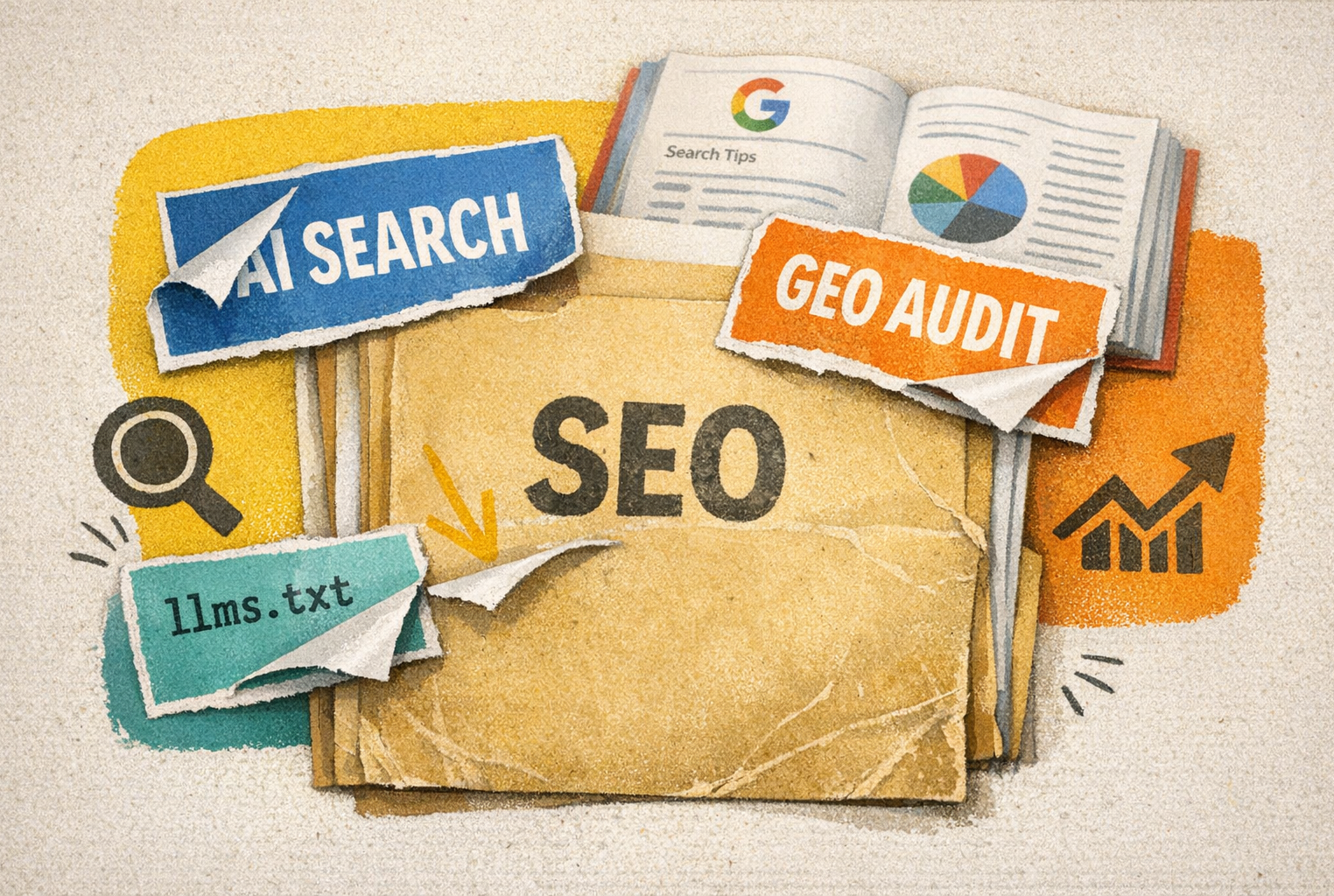
 Is your inbox full of pitches for “AI search” retainers, GEO audits and llms.txt implementation? Here is some cover for that. Google recently published its first official guide to optimising for its AI search features, and the headline for anyone being sold a pivot is short. This is still SEO.
The guide sits inside Google Search Central, next to their standard SEO documentation. It introduces no new ranking system. AI Overviews and AI Mode draw on the same index and the same quality signals as ordinary search, so the work that already earns your organic revenue is the work that gets you into AI answers.
For a busy marketer, the value is in two things today: what you can stop worrying about, and the one place the bar has genuinely moved.
Google is unusually direct about the tactics that don’t help. An llms.txt file does nothing, because its systems ignore it. There is no need to chunk content into tiny pieces for machines to parse, since the index already reads multiple topics on a page and serves the relevant part. A stilted “AI-friendly” rewrite buys you nothing, and nor does bespoke schema invented for AI Overviews. Manufactured mentions scattered across forums won’t shift you either.
Several of those are staple line items on the AEO and GEO retainers currently doing the rounds. For Beth Moore, Head of Client Services here at Door4, that list matters because it kills the idea that AI search is a separate craft. The same principles apply, and the industry doesn’t need to overcomplicate it.
Here is the change worth acting on, and the competitive cost behind it. That’s the part Beth keeps coming back to with our clients. “If you’re not getting it right and your competitors are, they’ll be cited before you in the same sense as they’d rank better than you.”
That’s E-E-A-T doing its job: experience, expertise, authoritativeness and trustworthiness, the signals Google and AI systems lean on to decide which sources earn a citation. Generic articles built from second-hand research barely move the needle now, because the web is already saturated with them. What gets cited is material that shows real expertise, original insight, and an author who is accountable for it.
Megan Jones, SEO Executive, sees the same pattern across this year’s briefs.
Google is full of information. Because people’s research is now done mostly on Google, it’s increasingly rare for an article to offer something it hasn’t already seen. That makes it far more important to include content from specialists and professionals in the field you’re writing about. EEAT has always mattered, but right now it feels like the deciding factor.
Worth a caveat here, because it’s easy to miss. Tidy headings and a clean structure are still good practice, but on their own they won’t get you ranked in an AI Overview or cited by a chatbot. Structure earns you readability. First-hand expertise earns you the citation.
For an e-commerce team, non-commodity content is whatever only you can credibly publish. It is the fit and sizing notes your customer service team builds from returns, the care guidance your product specialists know by heart, and the honest comparison that shows the trade-offs between two ranges rather than listing features. Put a named author against it, show why they are qualified, and you give an AI answer a reason to cite you over a catalogue.

The guide quietly points e-commerce teams back to a fundamental that rarely gets airtime in the AI conversation: your product data. AI features and shopping surfaces lean on structured, current product information to understand and compare what you sell. If your Merchant Center feed is thin, inconsistent or out of date, you make it hard to be surfaced or cited, even when your on-site content is strong.
Treat the feed as a live catalogue, not a one-off upload. The fields that earn their keep:
Make it someone’s job, with weekly checks, and line the product page’s structured data up with the feed so Google sees one source of truth. None of it is glamorous, but when AI features read from your product data, sloppiness becomes a visibility tax.
So what does the guide actually change? For most businesses, very little, and that is the point. The harder part of the week, for Beth, is the anxiety the noise creates.
Megan has had the same conversation with almost every client this year.
The one thing she is keeping an eye on is agentic AI, the browser agents that can compare products and complete a purchase on a customer’s behalf. Even there, the preparation is identical. A fast, well-structured, crawlable site with clear content is precisely what those agents depend on, so the fundamentals hold and the stakes simply rise.
The pitch economy around GEO and AEO will keep rolling regardless. Treat this guide as reassurance for your board rather than a reason to act: the plan you already have is likely doing the AI job too, so there’s no separate budget to find. Where the commercial gains actually sit is duller and more durable, the expert voices, the guides only you could write, and the product data that stays correct as your catalogue moves.



Our latest articles, features and ramblings.
We explore performance marketing, AI, communications and optimisation.