
Close
Menu
  1. Home /
  2. Our work /
  3. Forbes Solicitors – E.E.A.T
Forbes Solicitors

Growing qualified enquiries through stronger EEAT visibility

  • Content
  • SEO Strategy
  • Organic form submissions grew 56% YoY
  • Building a scalable framework to last

The Diagnosis

Turning hidden legal authority into visible trust across competitive search landing pages

Forbes Solicitors have strong real-world credentials, but key landing pages were not presenting that authority clearly enough.

As a full-service regional law firm with offices across the North West and London, the firm supports both private individuals and businesses through a wide mix of legal services. Legal services sit within Google’s Your Money or Your Life category, which means Google judges the content to a high standard. Users need confidence quickly, and Google expects strong signals of experience, expertise, authority, and trust (EEAT).

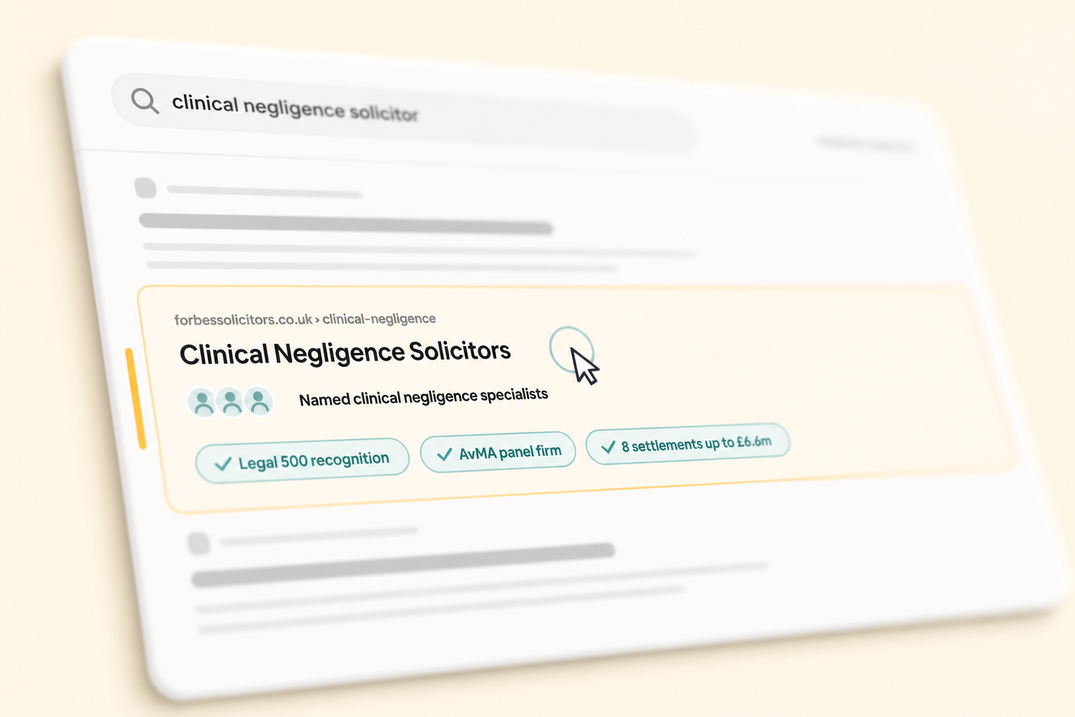
Forbes already had strong credentials: experienced practitioners, accreditations, award nominations, national media coverage, Legal 500 recognition, specialist partnerships, and proven case outcomes. But much of that strength was hidden on profile pages, team pages, PDFs, or internal materials.

The aim was to bring that proof and credibility onto the pages that mattered most. Door4 needed to help Forbes compete against larger national firms while keeping the website clean, useful, and easy to read.

The Approach

Building an evidence-led SEO strategy around real expertise, not generic legal content

Door4 approached the project as a commercial SEO and content strategy challenge. The objective was to improve EEAT scores across key practice area landing pages, support ranking recovery through Google volatility, and increase higher-intent organic enquiries.

We started by benchmarking Forbes against leading national competitors. This showed the real problem. Forbes did not lack authority. It lacked visible authority at the point where users and search engines first landed.

For example, the Clinical Negligence page scored 77/100, a Grade C, while one competitor scored 91 and another scored 87. When team information was surfaced, Forbes’ modelled score rose to 88, within three points of the market leader.

That insight shaped the strategy. We focused on consolidating existing proof: named practitioners, panel memberships, case outcomes, settlement examples, review signals, departmental expertise, Legal 500 and Chambers-style positioning, and relevant partnerships such as AvMA helpline involvement.  

The Execution

Rolling out enriched content department by department while protecting the user experience.

The project needed careful execution because legal content carries real responsibility. We introduced Door4’s proprietary Context Engine workflow to collect stronger information from departmental experts, structure it clearly, and turn it into human-first landing page content.

We worked collaboratively with Forbes’ teams to gather redacted case studies, operational insights, process detail, realistic timelines, outcome examples, and practitioner credentials. Accuracy mattered, so claims were checked with the client before they were used.

The content style shifted from formal, generic legal copy toward clearer, more reassuring language. The goal was to help a visitor quickly understand who would handle their matter, what experience the firm had, and why Forbes could be trusted.

There was also a UX challenge. Strong EEAT pages need depth, but users need clarity. We balanced evidence-rich content with Forbes’ sleek black-and-white page aesthetic, adding proof points, team visibility, and case-study content without creating a wall of text. The programme then scaled across all other departments.

The Success Criteria

Measuring success through the EEAT scores, ranking movement and enquiry growth

Success was measured through a mix of search performance, content quality, and commercial impact.

The first benchmark was EEAT score improvement. Door4 tracked page scores, grades, and pillar-level movement across Experience, Expertise, Authority, and Trust. We also compared Forbes directly against priority competitors to show whether the gap was closing.

The second measure was organic visibility. We monitored keyword ranking movement across key departments using SEO tracking data, with average position gains reported for areas including Business Crime, Corporate Law, Court of Protection, Clinical Negligence, Contentious Wills, and Intellectual Property.

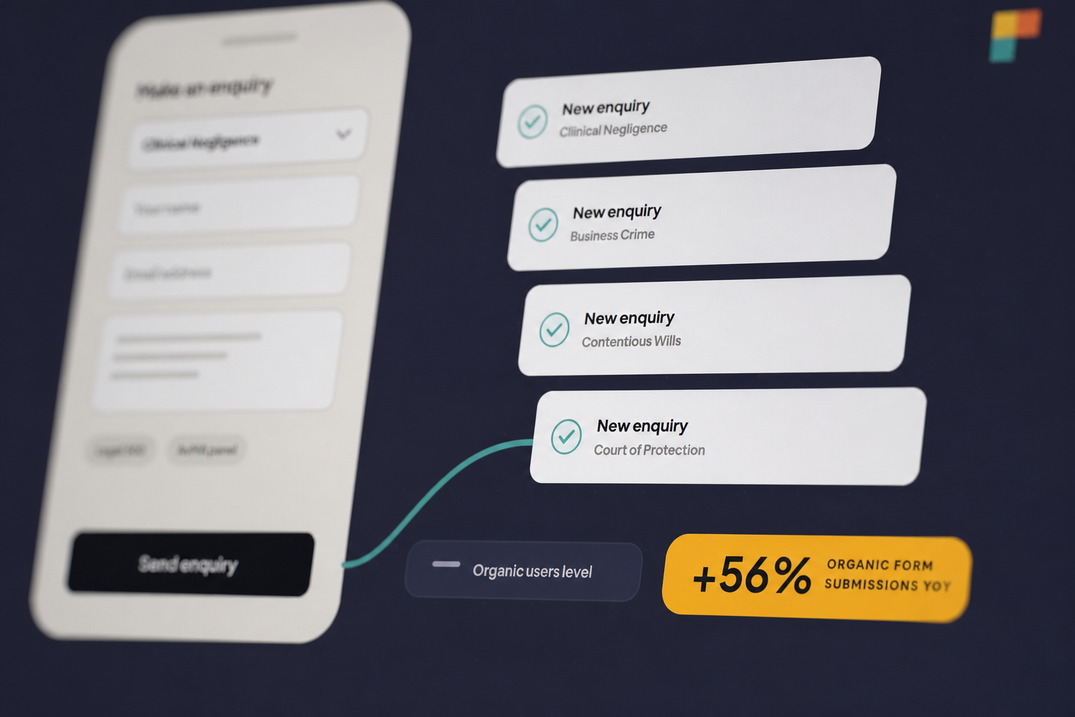
The third measure was lead quality and volume. Organic users broadly held flat year-on-year, while organic form submissions increased 56% YoY. That showed the work was improving intent and conversion, rather than simply chasing traffic.

Client outcomes & beyond

Giving Forbes a scalable model for stronger search visibility and higher-intent enquiries

The outcomes were both measurable and strategically useful. Clinical Negligence moved from 77/100 to 84/100 with enriched content, then to 88/100 once team information was incorporated. That moved Forbes from fifth to second in the competitive EEAT ranking, ahead of a top competitor and within three points of the market leader.

Business Crime showed the wider potential of the model. Its original generic content scored 44/100, a Grade F. The enriched content projected an 85/100 score, a Grade B, and achieved #1 in EEAT rankings for the draft content set.

Forbes already had the authority. Door4 helped make it visible. The firm now has a repeatable content framework that supports ranking resilience, stronger user trust, and more qualified enquiries across practice areas.

Does this kind of success work for you?

If you'd like to work with a performance marketing agency that will help you exceed your commercial goals, we can start on it right away. Get in touch.

Proud to work with