
Innovation Explorer - Request a call
Ready to explore the possibilities?
Request a quick call with our team to find out how the Innovation Explorer program can help your business take its next big leap into AI and automation.
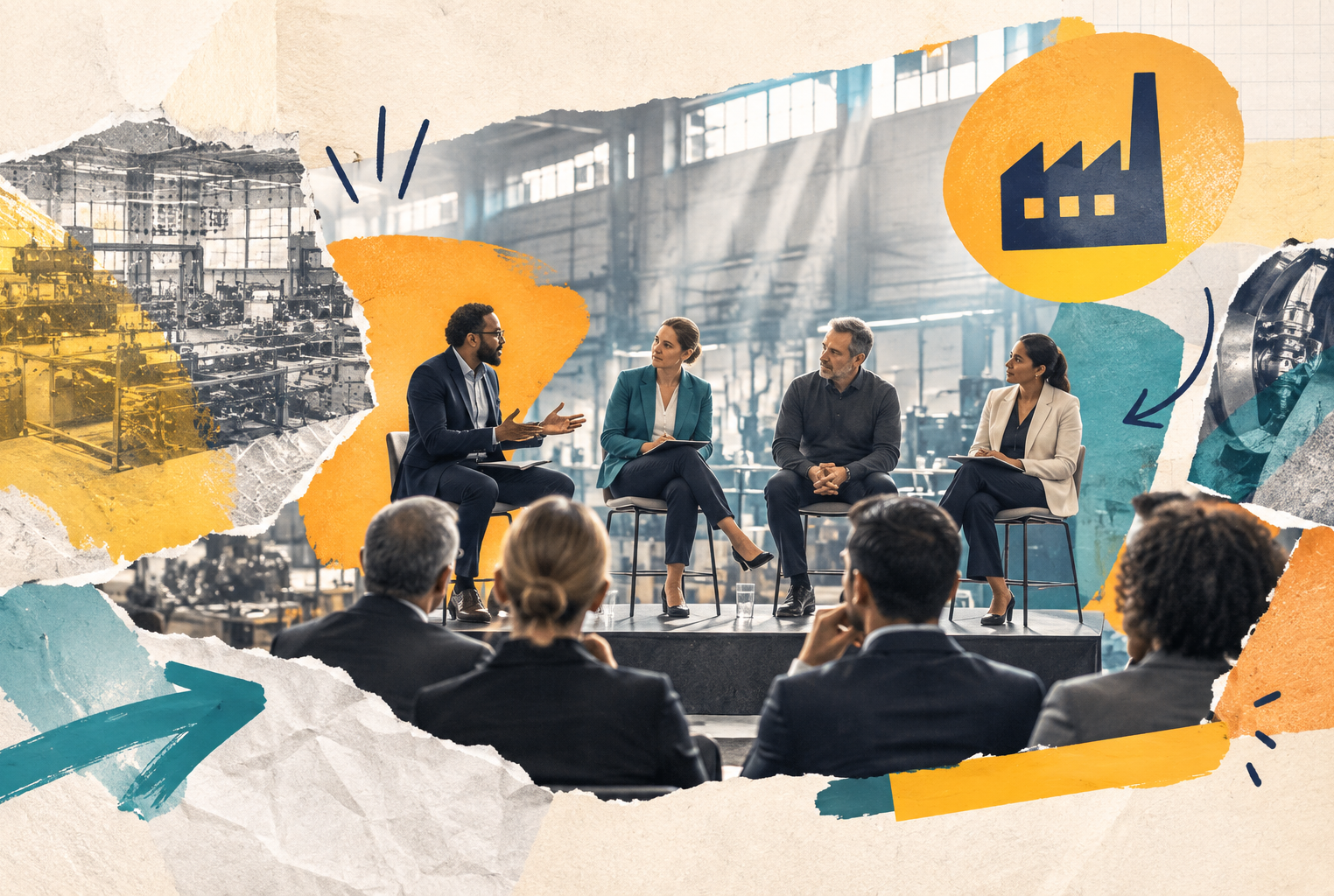
Marketing agencies started experimenting with AI early, mostly because the raw material suited it. Data in, data out. Fewer physical constraints, faster feedback loops, lower cost of getting it wrong. That head start is exactly why Door4 founder Leon Calverley has been asked onto the ‘Art of the Possible’ panel at Smarter Manufacturing, an event organised by Made Smarter, RTC North and Seriun, hosted at Safran Nacelles’ Burnley site on 22 September.
The audience is manufacturing leaders, not marketers. But the underlying question is the same one every sector is asking: where does AI genuinely extend what a team can do, and where is it just a smarter way to cut cost?
Manufacturing has, by most accounts, been slower to answer that question than information-led industries. A recent report found manufacturers, particularly SMEs, stuck in what’s been called a “pilot trap” – projects that get started but stall, held back by legacy production systems, fragmented industrial data, and unclear return on investment. That’s a different problem to the one marketing faced. It’s also, on current evidence, a gap that’s closing fast: AI use in manufacturing has more than doubled in the last two years, even from a modest base.
Leon’s read on the gap is straightforward. IT, marketing, finance and professional services businesses could experiment cheaply because their inputs and outputs were already data. Manufacturing is different by design: years of optimised, physical, interdependent operations don’t get undone in a year or two without introducing more complexity than they solve. Add real, escalating cybersecurity risk in a sector where legacy systems are a known target, and caution isn’t reluctance. It’s prudence.
The argument Leon will make on the panel is a general one, not a marketing pitch dressed up for a new room: AI should expand what a team can attempt, not just shrink what it costs to run. That applies whether the team is running SEO campaigns or scheduling a production line.
The distinction matters because most conversations about AI in business default to the same shape: fewer people doing the same work. That’s a real use case, but it’s the smallest one. The more useful question is what a team could take on if the constraint on their time and attention loosened – what gets attempted that wasn’t worth attempting before.
Two capabilities do most of the work here: reasoning and forecasting. Both are relevant wherever decisions get made under uncertainty, which in a manufacturing context means most of the interesting decisions. Not because AI removes the uncertainty, but because it changes how quickly and how cheaply you can test a hypothesis about it.
That’s the multiplier effect worth paying attention to: the same team, the same headcount, doing more with it. Not a bigger team. Not a smaller one. More output from the resource already in the building.
None of that works without the basics being right first. Clean data. A clearly defined problem. A process that’s understood well enough to know what “better” would actually look like. AI amplifies whatever it’s given – a well-defined problem gets solved faster, but a messy one just gets messier, faster.
This is where the pilot trap tends to spring: teams reach for the tool before they’ve agreed what they’re trying to fix, and the technology takes the blame for a problem that was there before it arrived. The businesses making genuine progress, in marketing or elsewhere, are the ones who did the unglamorous work first.
Leon will be joining a panel discussion alongside leading manufacturers and technology businesses, including Safran, MGS Plastics and Process Instruments, at the Smarter Manufacturing event on 22 September. The aim, in his words, is practical: even one usable idea from the day counts as a result worth having.
If you’re attending, look out for the ‘Art of the Possible’ panel, or come and find Leon on the day.
Our latest articles, features and ramblings.
We explore performance marketing, AI, communications and optimisation.