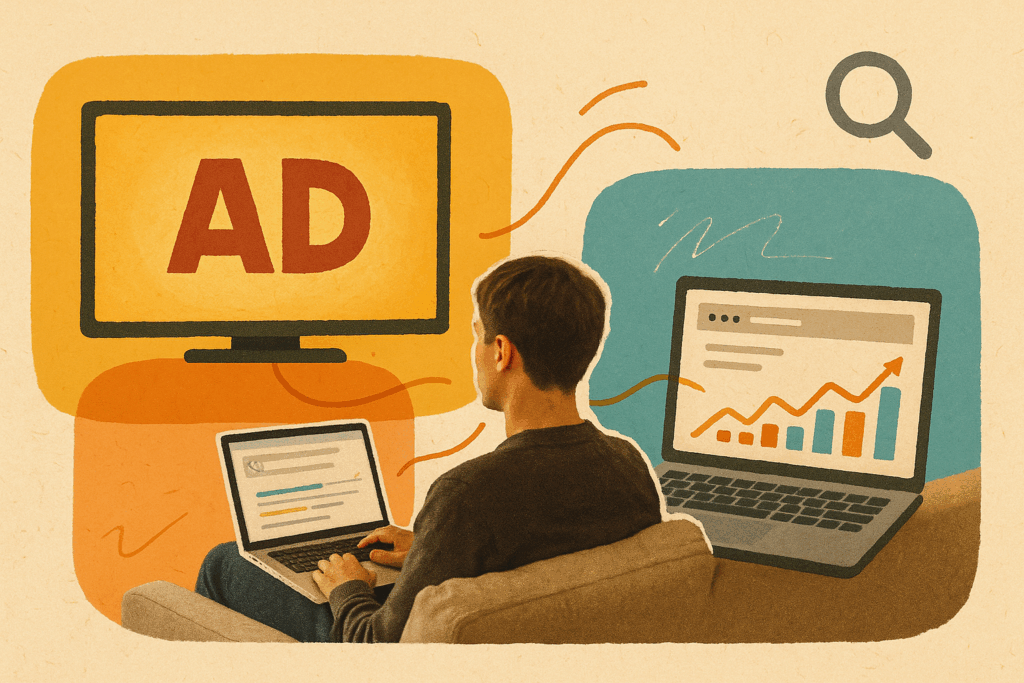
TV advertising isn’t a relic. It’s still one of the most powerful ways to capture attention, and, when paired with digital performance channels, it drives real commercial outcomes.
On World Television Day, we’re looking at how brands can use TV to amplify PPC, SEO, and conversion activity. The question isn’t does TV still work? It’s how can it work better alongside digital?
Why TV still matters
Television remains a cultural meeting point. It shapes conversations, builds trust, and creates shared moments that spill over onto search and social. When those moments connect with digital channels, the impact multiplies.
TV’s evolution is part of the story. We’ve moved beyond traditional broadcast to addressable, data-driven formats like AdSmart – where brands can still reach mass audiences but with pinpoint precision.
As Natalie Guest, Regional Sales Manager, AdSmart from Sky – Cheshire and Lancashire at Sky, explains:
“TV advertising is playing a bigger role than ever in connecting with digital activity. With AdSmart, brands can show their ads to specific audiences while still benefiting from the trust and impact of TV. This helps boost engagement and improves results across digital channels too. As AI makes it easier to plan and measure campaigns, we are seeing marketing become more joined up and effective across every platform.”
That’s the key. When TV and digital work together, you get brand reach and measurable response. One builds memory; the other captures intent.
The brand-performance balance
Marketers have spent years chasing short-term gains – optimising clicks, conversions, and costs. But as privacy rules tighten and AI evens out the playing field, long-term brand strength is what keeps growth sustainable.
The IPA’s long-standing evidence backs this up: balanced investment in brand and activation consistently outperforms extremes. TV is the memory builder. PPC, SEO, and CRO are the activators.
When aligned, these channels don’t fight for budget — they fuel each other.
TV and PPC: the bridge from attention to action
Think of PPC as your quick-response unit. When a TV campaign lands, people search almost immediately – sometimes for slogans, sometimes for the offer they just saw.
That’s where alignment matters. Tom Morton, Head of Activation at Door4, sums it up perfectly:
 “When TV drives recall, people are already in-market when they then search or click. You cannot just rely on SEO to catch that moment because the intent is high and time-sensitive. At that point, PPC becomes the bridge from brand familiarity to action. For example, the Coca-Cola Share A Coke campaign spiked search interest for the brand and variants like Coke names shortly after the TV and OOH launch. With that kind of lift in recall and curiosity, your PPC copy-and-keyword alignment can turn that interest into a click-and-convert moment much more cost-effectively, especially if the end point is a digital action.”
That bridge depends on execution. Here’s what we recommend:
- Match your messaging. Use the same phrasing from your TV creative in your ad copy. People will search for what they hear, even the misheard versions.
- Sync your budgets. If your ads run by region or daypart, adjust your bids and impression share in line with the broadcast schedule.
- Protect your brand. Expect competitors to bid on your name when you’re on air. Keep defensive campaigns active and your sitelinks sharp.
- Track live impact. Compare cost per conversion, CTR and impression share when TV is live vs off-air. Look for the lift.
It’s all about rhythm… TV sparks demand, PPC captures it.
TV and SEO: sustaining the momentum
Where PPC handles the surge, SEO builds the foundation. When TV primes the audience, SEO ensures you’re visible and credible when they search.
Start with relevance. Create landing pages that reflect your TV messaging. Update your metadata, knowledge panels, and structured data so search engines connect the dots. If your ad features a unique product, tagline or personality, make sure that’s searchable and explained.
Then think long-term. TV can lift branded searches for months after a campaign if your content keeps feeding the topic. Use that time to reinforce authority: publish related stories, update product pages, and keep journalists and creators linking back.
Done right, SEO turns TV buzz into lasting visibility, and frees paid budgets for broader, growth-driving terms.
CRO: the multiplier that converts attention
Traffic without action is just noise. Conversion rate optimisation (CRO) turns TV-driven visits into measurable outcomes.
When a campaign goes live, the landing experience has to reflect what viewers just saw. If your ad promises a 30-day trial, that offer should dominate the page. If trust is your theme, lead with reviews and guarantees. Even embedding a short cut of the TV ad can reassure visitors they’re in the right place.
And speed matters. TV drives mobile spikes, a one-second delay in load time during a campaign can mean the difference between a conversion and a bounce.
The best teams treat CRO as a live discipline, testing creative, headlines, and layouts during the campaign. It’s not about big redesigns, it’s about message match and timing.
The AI layer
AI is accelerating how teams plan, produce, and optimise campaigns, and that’s especially useful for integrating TV and digital.
Predictive tools can now estimate how much branded search lift a TV burst will generate, allowing PPC teams to pre-set bids and budgets. AI-assisted bidding then reacts in real time as those searches spike.
On the creative side, AI can test attention and recall before the ad airs. And for SEO, models can map out intent patterns tied to your campaign themes, helping you produce content that meets demand faster.
As Natalie Guest mentioned, AI is making campaigns “more joined up and effective across every platform.” But sameness is the risk. If every brand uses the same automation, differentiation fades. What keeps performance strong is creative thinking, cross-team rhythm, and testing in market — not in theory.
What’s next
Three trends will define how TV and digital work together in 2025 and beyond:
- Brand-first planning. As customer acquisition costs rise, expect more brands to invest steadily in mental availability rather than sporadic bursts. Pair that with always-on PPC and content-led SEO.
- Smarter measurement. Media mix modelling is back – this time connected to real-time finance and forecasting tools. It’ll help prove TV’s incremental value by region and audience.
- Generative Engine Optimisation (GEO). As AI-driven search results summarise the web, structured, authoritative content will win. TV campaigns that generate press coverage and third-party mentions feed directly into this.
How integrated teams win
The most effective campaigns are built on partnership. Invite your agency into planning and data, not just reporting. Shared context leads to faster iteration and clearer accountability.
As Tom Morton puts it, “brand and performance are not separate things. They feed each other.” Your team structures should reflect that.
Build a shared scoreboard; a handful of metrics everyone can influence, like branded search volume, incremental conversions during TV flights, organic share of voice, and on-site conversion rate.
And run a campaign hub: one owner, one cadence, all disciplines at the table. Media, creative, PPC, SEO, CRO, analytics. It’s the simplest way to avoid leaks when the campaign is live.
The takeaway
TV builds the story. Digital turns it into action. Together, they create momentum that no single channel can achieve alone.
Before your next TV launch, ask three questions:
- Can you explain the promise in one clear sentence?
- Does your PPC copy echo it?
- Can a new visitor see and believe it within three seconds on your site?
If the answer is yes, you’ve built an integrated, AI-aware marketing system that drives both brand growth and measurable performance.
That’s what we aim for at Door4: partnership, clarity, and results, with brand and performance working as one.
Contributors
- Natalie Guest — Regional Sales Manager AdSmart from Sky – Cheshire and Lancashire, Sky. LinkedIn
- Tom Morton — Head of Activation, Door4. LinkedIn
Thank you to our contributors for sharing their insights and experience. Your perspectives help make sense of how TV and digital can work better together.


 “When TV drives recall, people are already in-market when they then search or click. You cannot just rely on SEO to catch that moment because the intent is high and time-sensitive. At that point, PPC becomes the bridge from brand familiarity to action. For example, the Coca-Cola Share A Coke campaign spiked search interest for the brand and variants like Coke names shortly after the TV and OOH launch. With that kind of lift in recall and curiosity, your PPC copy-and-keyword alignment can turn that interest into a click-and-convert moment much more cost-effectively, especially if the end point is a digital action.”